The Loire Valley is not one castle but a hundred of them, strung along a river that once carried kings, courtiers and the money that followed them. For about a century this stretch of central France was the political heart of the country, and the châteaux that survive are the receipts: fortresses softened into pleasure palaces, hunting lodges built to impress, gardens laid out as carefully as the state rooms. You can see the famous ones in two busy days, but the valley rewards a slower approach.
Why the Loire Became Castle Country
Geography did most of the work. The Loire was the main east–west artery before railways, and the limestone beneath the valley was easy to quarry and carve. After the Hundred Years' War, with the English pushed out and Charles VII's court re-established in Touraine and Anjou, the crown and the nobility settled here. The Italian wars then brought Renaissance ideas north: regular façades, wide windows, arcaded galleries, and staircases meant to be seen rather than defended.
Louis XIV's move to Versailles in the 1680s pulled the aristocracy towards Paris, and the valley lost its political purpose. That exodus is a gift to visitors now. The region froze at the peak of its wealth, so most of what you see is sixteenth-century work rather than centuries of later remodelling.
The Royal Set-Pieces
Chambord
Chambord defeats photographs. François I began it in 1519 as a hunting retreat, and the scale is absurd: a central keep with four round towers, a roofscape of chimneys and lanterns best seen from the terrace, and a walled forest wrapped around the whole thing. The double-helix staircase lets two people climb without meeting. Interiors are sparsely furnished, so treat Chambord as an architectural experience rather than an interiors one.
Blois and Amboise
Blois compresses four centuries into one courtyard: a medieval hall, the flamboyant Gothic wing of Louis XII, the Renaissance François I wing with its open spiral staircase, and the colder classical block of Gaston d'Orléans. It is the clearest lesson in French architectural change you will get anywhere.
Amboise sits above the river with the view that explains why the court liked it. The château is smaller than its reputation, but the town matters: Leonardo da Vinci spent his last years a short walk away at Clos Lucé and died there in 1519. See both in one visit.
Chenonceau
Chenonceau is the postcard, built across the Cher on a series of arches with a long gallery by Philibert de l'Orme. Henri II gave it to his mistress Diane de Poitiers; after his death Catherine de' Medici took it back and made it grander, and the two facing gardens still carry their names. Arrive early — the galleries are narrow and queues build quickly.
Gardens, Interiors and the Smaller Stars
If you want furnished rooms rather than empty grandeur, head for Cheverny, still lived in by the family that has owned it since the seventeenth century. Its interiors are complete, and the hounds and kennels remain part of daily life there. Hergé borrowed the façade for Marlinspike Hall in the Tintin books, a detail that delights some visitors and baffles others.
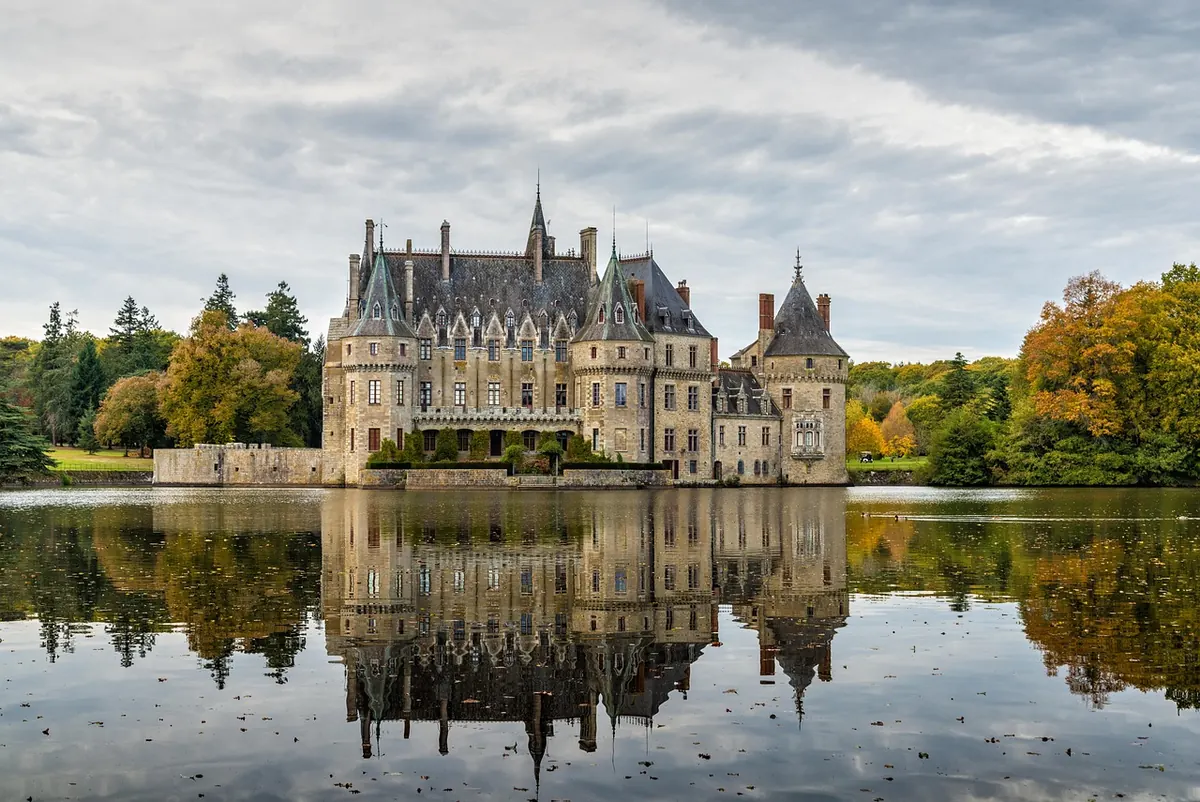
Villandry is a garden with a château attached: six terraces, water features, and an ornamental kitchen garden replanted twice a year. Azay-le-Rideau is about reflection, a Renaissance château on an island in the Indre, best seen in still, early light. Ussé looks so like a fairy-tale illustration that it has been linked to Sleeping Beauty for over a century. Chinon offers the opposite mood: a ruined fortress on a rocky outcrop where Joan of Arc met Charles VII in 1429.
What to Look For Once You Are Inside
The interiors can blur together after the third visit. Focus on a few repeated details and they won't:
- Staircases. The open straight or spiral stair is the great Renaissance showpiece — the wider the tread and the lighter the stone, the later the date.
- Fireplaces. Carved chimney pieces carry the owner's initials and emblems, sometimes a crowned salamander (François I) or a porcupine (Louis XII).
- Ceilings. Exposed beams suggest medieval or early Renaissance work; coffered or painted ceilings point to Italian taste.
- Floor plans. Long enfilades of rooms connected end to end are a court invention. Older buildings have rooms opening off a single hall.
- Gardens. Parterres are documents. Geometry, colour and the choice of vegetables all reflect the fashion of the moment they were restored to.
Getting Around the Valley
The valley runs more than 200 km from end to end, so pick a stretch rather than trying to cover everything. Tours and Blois are the two most useful bases; Amboise suits anyone who wants a smaller town with a château on the doorstep. Regional trains follow the river and call at Amboise, Blois, Chenonceaux, Saumur and Angers, which covers a surprising number of headline sites without a car.
Chambord is the notable exception. It has no station of its own, so most visitors arrive by car or on the seasonal shuttle from Blois. Cycling fills the gap nicely: the Loire à Vélo route follows the river for hundreds of kilometres, and short local loops let you link a station, a château and a village lunch in one afternoon. Distances look short on a map, but the valley floor is wide and flat; allow more time than you expect for the gaps between sites.
Practical Notes Before You Go
Tickets at the major châteaux are not cheap, and the big names sell timed-entry slots in summer. Booking online a day ahead usually saves queuing, and a regional pass can pay off if you plan to visit four or more sites.
- Travel in shoulder season — late April to June, or September. The weather is generally kind and the galleries are quieter.
- Start early. Most châteaux open between 9am and 10am, and the first hour is the calmest.
- Check opening days before you drive anywhere. Several properties close on Mondays or Tuesdays, and many shut entirely in January and February.
- Build in a long lunch. The market towns and riverside villages are part of the experience, not just a stop between monuments.
- Wear shoes for gravel. You will spend as much time in courtyards, gardens and forest paths as on parquet floors.
One last piece of advice: choose two or three châteaux to see properly rather than six in a blur. The Loire makes most sense at the pace of a walk through a garden, not a checklist.
Photo: Ladyhester / Pixabay